
The image above was generated by AI for this paper (ChatGPT Images 2.0)1Image generated in a few seconds, on 11 June 2026, text prompt by Alan D. Thompson, via ChatGPT Images 2.0: ‘absolutely massive sky, real but magical and enhanced, person for scale.’
Alan D. Thompson
June 2026
| Date | Report title |
| Mid-2026 | The sky is massive |
| End-2025 | The sky is supernatural |
| Mid-2025 | The sky is delivering |
| End-2024 | The sky is steadfast |
| Mid-2024 | The sky is quickening |
| End-2023 | The sky is comforting |
| Mid-2023 | The sky is entrancing |
| End-2022 | The sky is infinite |
| Mid-2022 | The sky is bigger than we imagine |
| End-2021 | The sky is on fire |
The trajectory of artificial intelligence presented a parallel case of civilisational lag. From at least 2021, contemporaneous observers documented escalating AI capability as a matter of public record, and in some instances submitted formal warnings to international bodies. Independent estimates placed AGI probability above 80% by 2024, yet governance frameworks remained embryonic, political leaders were widely characterised as negligent, and the institutional machinery of employment, finance, and daily labour continued operating with minimal structural reform.
— Pre-ASI Society article (May/2026)2https://lifearchitect.ai/wiki/
Author’s note: I continue to advise major governments, family offices, research teams like RAND, and companies like Microsoft via The Memo: LifeArchitect.ai/memo.
In the previous AI report, The sky is supernatural, AI was working its magic on society. Frontier models were producing original scientific discoveries, solving long-standing mathematical conjectures, and generating insights that researchers called ‘alchemy’. Six months later, the world is responding with scale. Hundreds of millions of new users. Billions in capital. And more than a dozen new trillion-parameter models.
The word for the first half of 2026 is massive. Every metric is growing at once, so let’s take a look.
Users. ChatGPT reached one billion monthly app users.3https://www.cnbc.com/2026/06/12/chatgpt-a-billion-monthly-app-users-despite-souring-public-ai-sentiment.html The Gemini App passed 750 million monthly active users,4Alphabet Q4 2025 earnings (4/Feb/2026). https://blog.google/company-news/inside-google/message-ceo/alphabet-earnings-q4-2025/ with users creating a billion images using Nano Banana Pro.5https://x.com/joshwoodward/status/2010806443314987295 Malta became the first country to offer ChatGPT Plus to all citizens.6OpenAI (16/May/2026). Malta national programme. https://openai.com/index/malta-chatgpt-plus-partnership/ 16.3% of the world’s population used generative AI tools, with the UAE leading at 64% adoption.7Microsoft AI diffusion data (14/Feb/2026). Global at 16.3%; UAE 64%, Singapore 61%. https://www.microsoft.com/en-us/corporate-responsibility/topics/ai-economy-institute/reports/global-ai-adoption-2025/
Compute. Training compute grew roughly 5,000× from 2023–2026, as measured by MIT using LifeArchitect.ai data. A parallel Harvard/Stanford study (also using LifeArchitect.ai data) confirmed: scale drives AI performance, and for most tasks more compute means better results in a predictable way.8Harvard/Stanford (17/Feb/2026): https://arxiv.org/abs/2602.15327 & MIT (6/Feb/2026): https://arxiv.org/abs/2602.07238v1 Google now controls roughly a quarter of all AI compute on Earth: 3.8 million TPUs and 1.3 million GPUs.9https://blog.google/company-news/inside-google/message-ceo/alphabet-earnings-q4-2025/ A single Google TPU 8t superpod (9,600 chips) delivers 121 ExaFlops, with near-linear scaling to a million chips.10Google (23/Apr/2026). TPU 8t and TPU 8i, eighth-generation. https://blog.google/innovation-and-ai/infrastructure-and-cloud/google-cloud/eighth-generation-tpu-agentic-era/
Output tokens. Humans speak and write a total of about 176 trillion tokens per day. In March 2026, China’s total model output hit 140 trillion tokens per day, reinforcing my forecast of all models in all countries matching human output by June 2026. This will triple to 600 trillion by year-end, and hit 6 quadrillion by the end of next year.
 Chart. Total AI output exceeds human output in mid-2026. LifeArchitect.ai/output.
Datacenters. Global datacenter spending is approaching US$1 trillion in 2026, with up to US$700B anticipated in the US alone. Datacenters now consume 6% of all US electricity, a 36% jump in power draw over two years. Datacenter construction surpassed office construction in the United States for the first time.11https://singularityhub.com/2026/05/22/data-centers-now-consume-6-of-electricity-in-the-us-and-the-backlash-has-begun/ US Census Bureau Construction Spending crossover (28/Feb/2026). Morgan Stanley forecast of US$3T. https://www.zerohedge.com/markets/ai-takeover-complete-data-center-construction-surpasses-office-construction-first-time12Claude Fable 5 broke my XML, and I can’t delete this footnote without corrupting the file. Maybe AI ain’t that smart after all…
Infrastructure. The Stargate project now has all seven sites under active development across Texas, New Mexico, Wisconsin, Michigan, and Ohio, with a combined planned capacity exceeding 9 gigawatts, comparable to the peak power demand of New York City. At full buildout, the infrastructure will power the equivalent of 20 million NVIDIA H100 GPUs, which was the total amount of AI compute in the entire world at the end of 2025.13Seven Stargate sites, 9GW+ combined. https://epoch.ai/blog/openai-stargate-where-the-us-sites-stand
Capital. AI capital expenditure is projected to exceed US$500B in 2026.14https://www.americafirstpolicy.com/issues/the-data-center-water-use-hoax Google alone committed US$175–185B in CapEx.15reuters.com OpenAI’s total Stargate infrastructure commitment has expanded to US$1.4 trillion.16Bloomberg (19/Feb/2026). OpenAI/Tata; Stargate at US$1.4T. https://archive.md/VL7Jw OpenAI is spending US$20–30B on Cerebras chips alone.17https://archive.md/CtL4p
Revenue. Anthropic’s annualised revenue jumped from ~US$9B at the end of 2025 to ~US$30B by April 2026, said to be ‘possibly the fastest-growing business in the history of capitalism’.18Anthropic/Google/Broadcom partnership (6/Apr/2026). https://www.anthropic.com/news/google-broadcom-partnership-compute The Atlantic (1/May/2026). https://www.theatlantic.com/economy/2026/05/ai-bubble-revenue-anthropic/687022/ Claude Code alone hit US$2.5B ARR in under a year,19Axios (1/Apr/2026). Claude Code source leak; US$2.5B ARR. https://www.axios.com/2026/03/31/anthropic-leaked-source-code-ai and Anthropic is spending US$1.25B per month on compute at SpaceX’s Colossus clusters.20SpaceX S-1 prospectus (20/May/2026). US$1.25B/month through May 2029 across Colossus 1 and Colossus 2. sec.gov
Agent capability. METR’s 50%-time-horizon estimate for Claude Opus 4.6 reached 14.5 hours on software engineering tasks, the highest ever recorded. The previous record was set two months earlier by GPT-5.2 at 6.5 hours. For the first time, a frontier AI model agent exceeded an 8-hour human workday task.21METR (21/Feb/2026): https://metr.org/time-horizons/ and https://x.com/METR_Evals/status/2024923422867030027
Cybersecurity. The massive Claude Mythos Preview model was applied to software, finding more than 10,000 vulnerabilities across critical infrastructure applications in its first month of Project Glasswing.22Anthropic, Project Glasswing (22/May/2026): https://www.anthropic.com/glasswing The Economist reported that Mythos ‘broke into almost all’ classified NSA and Pentagon systems, ‘not in weeks, but in hours’.23https://archive.md/aA1dB Mozilla fixed 271 security bugs in Firefox identified by Mythos, including 20-year-old latent issues.24Mozilla Hacks (7/May/2026). 271 bugs, 180 sec-high. https://hacks.mozilla.org/2026/05/behind-the-scenes-hardening-firefox/ Both Mythos and GPT-5.5 completed a 32-step corporate network attack simulation end-to-end.25AISI UK (30/Apr/2026). GPT-5.5 at 71.4% expert-level cyber. https://www.aisi.gov.uk/blog/our-evaluation-of-openais-gpt-5-5-cyber-capabilities
 Chart. Mozilla bug fixes 2025-2026. Mythos was made available to Mozilla in April 2026.
Large language models
My Models Table Pro documented more than 150 major new model highlights in the first half of 2026 (yes, that’s a cadence of about one new model every day), and now lists around 900 major large language models. Clients can filter and report on the full database at: LifeArchitect.ai/models-table-pro.
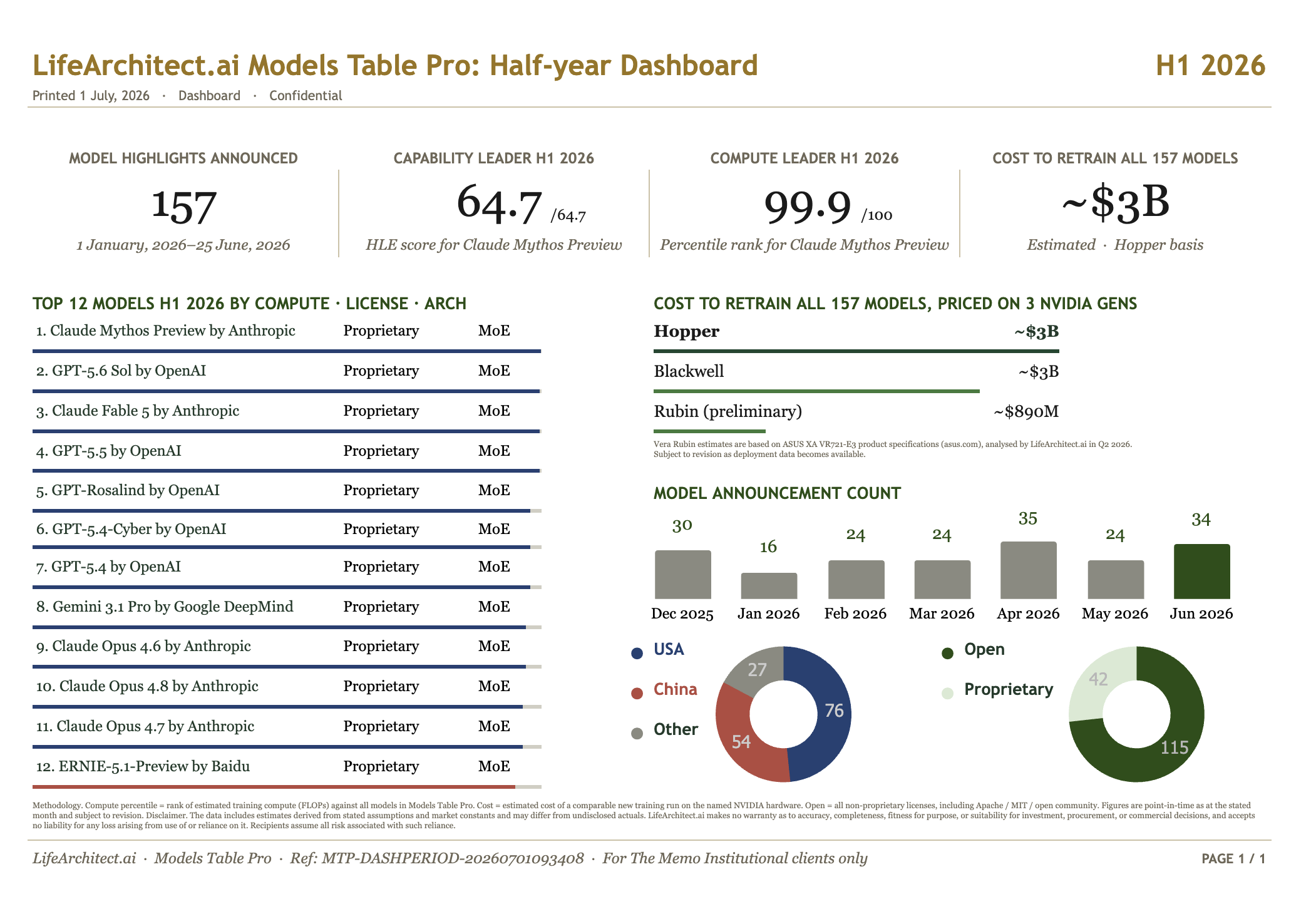 Viz. Models Table Pro: Half-year Dashboard. LifeArchitect.ai/models-table-pro.
A year ago, only a few labs outside the big five (OpenAI, Anthropic, Google, xAI, Meta) trained models of a trillion parameters or more. In the first half of 2026, another 17 models from 10 different labs, including Apple, Microsoft, and several Chinese organizations, have crossed that threshold, making it the new standard.26https://lifearchitect.ai/models-table-pro/
| Lab | Model | First release date | License | Total | Notes |
|---|---|---|---|---|---|
| Big 5 labs | Multiple | 2026 | Proprietary | – | OpenAI, Anthropic, Google, xAI, Meta |
| Apple | AFM 3 Cloud Pro | Jun/2026 | Proprietary | 1 | Gemini base |
| Microsoft | MAI-Thinking-1 | Jun/2026 | Proprietary | 1 | |
| Alibaba | Qwen3.6-Max-Preview; Qwen3.7-Max | Apr/2026 | Proprietary | 2 | ‘Alibaba launches Qwen3-Max AI model with more than 1 trillion parameters’ |
| DeepSeek AI | DeepSeek-V4-Pro | Apr/2026 | MIT | 1 | |
| Inclusion AI | Ling-2.5-1T; Ring-2.5-1T; Ling-2.6-1T; Ring-2.6-1T | Feb/2026 | MIT | 4 | Ling (language), and Ring (reasoning) |
| Meituan | LongCat-2.0 | Jun/2026 | MIT | 1 | |
| Moonshot AI | Kimi K2.5; Kimi K2.6; Kimi-K2.7-Code | Jan/2026 | Other | 3 | |
| Shanghai AI Laboratory /SenseTime |
Intern-S1-Pro | Feb/2026 | Apache 2.0 | 1 | ‘the first one-trillion-parameter scientific multimodal foundation model’ |
| Xiaomi | MiMo-V2-Pro; MiMo-V2.5-Pro | Mar/2026 | MIT; Apache 2.0 | 2 | 1M context |
| YuanLabAI | Yuan3.0-Ultra | Mar/2026 | Other | 1 | |
| Total: | 17 |
Table. Trillion-parameter-scale models released in the first half of 2026. LifeArchitect.ai/models-table-pro.
The largest model publicly revealed to be in training is a 10-trillion-parameter model, disclosed by Elon Musk in April 202627https://x.com/elonmusk/status/2041754402239975479 as one of several models running on SpaceX’s Colossus 2 cluster. For context, the massive GPT-4 model that reshaped the industry in 2023 was estimated at around 1.76 trillion parameters.28https://lifearchitect.ai/gpt-4/ The 10-trillion-parameter model is more than five times that size, and it is one of several models being trained at the same time in a single facility.
Performance
‘We consider GPQA Diamond to be a saturated evaluation and plan to stop reporting the performance of future models on it.’
— Anthropic’s Claude Fable 5 model card (June 2026)29https://www.anthropic.com/news/claude-fable-5-mythos-5
All major benchmarks have been saturated. You can read more about the ceilings at LifeArchitect.ai/mapping. Despite the ceiling breaches, here’s a look at the top models by GPQA and HLE scores to the end of Jun/2026.
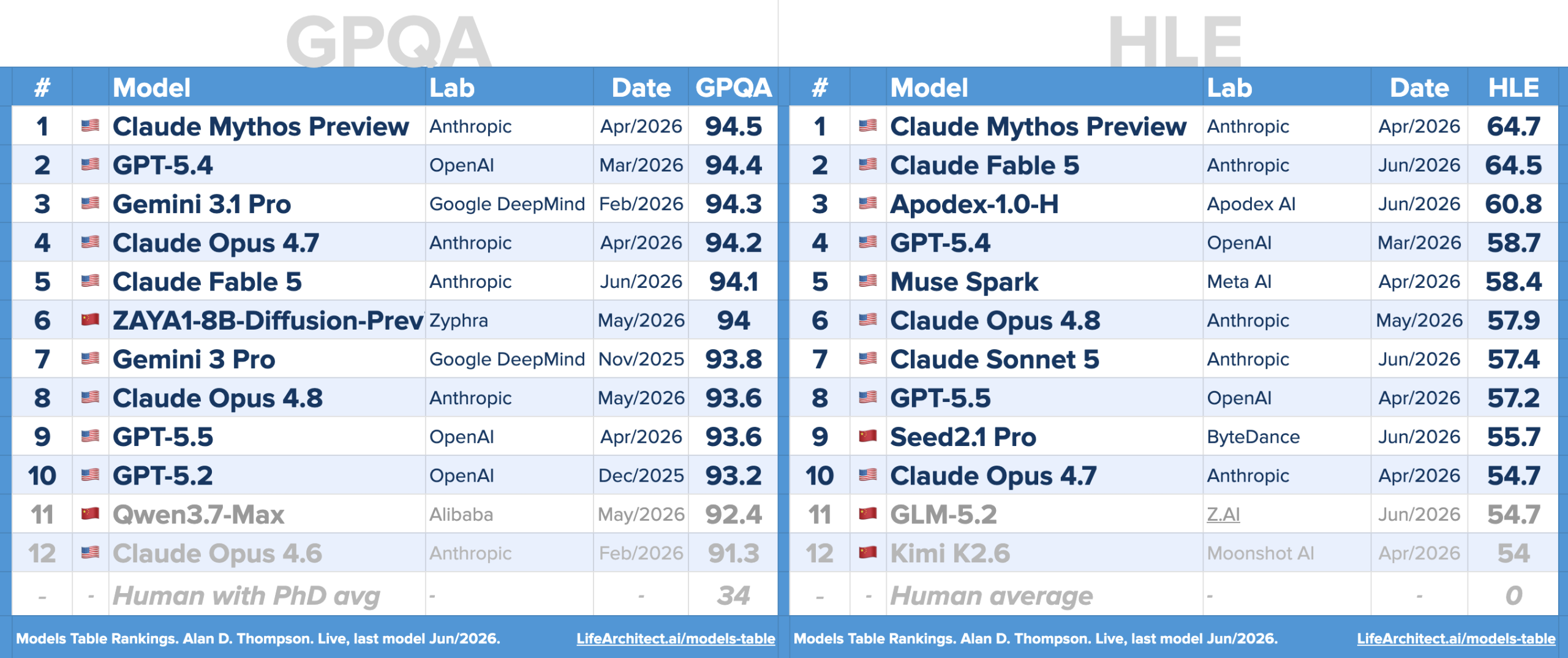 Table. AI rankings via GPQA and HLE to Jun/2026. LifeArchitect.ai/models-table.
AGI (artificial general intelligence)
For several years now, I’ve documented the progress of AI working its way toward performing at the level of an average (median) human across practically all fields. This is also known as artificial general intelligence (AGI). The ‘conservative countdown to AGI’ is one of my most-visited online resources.30https://lifearchitect.ai/agi/ Many experts (including the researcher who coined the term ‘AGI’) have now acknowledged that we have already achieved AGI.

ASI (artificial superintelligence)
ASI (artificial superintelligence) is a system that performs at the level of an expert human in practically any field. In the last report, I hinted that we should be prepared for ASI-level models that achieve extraordinary things for humanity, with examples like ‘Gemini 5 discovered a free energy source to replace oil & gas’ or ‘GPT-7 found a cure for leukemia’.
In February 2026, Claude Opus 4.6 became the first model to cross both of my ASI thresholds, scoring 53.1% on Humanity’s Last Exam and 91.3% on GPQA. The same month, Claude Mythos Preview finished training,31‘Following a successful alignment review, the first early version of Claude Mythos Preview was made available for internal use on February 24 [2026].’ PDF and it marks the fifth major step change in large language model capability, following base scaling, RLHF, synthetic data, and inference-time reasoning. Mythos’ defining characteristic is expert-level uplift, driven by what Anthropic describes as extremely large amounts of reinforcement learning on long-horizon agentic tasks.
 Chart. Major step changes in LLM capability (Jun/2026). LifeArchitect.ai/mythos.
Within hours of the Mythos announcement, major government and financial institutions began citing LifeArchitect.ai in characterising Mythos as an early ASI system.32https://lifearchitect.ai/mythos/ To put the pace in perspective, a detailed scenario published in early 2025 predicted a system with Mythos-level cyber capabilities would not arrive until early 2027. It arrived nine months ahead of that forecast.33https://ai-2027.com/race
In May 2026, an internal general-purpose OpenAI model achieved the first two ASI indicators on my ASI checklist.34https://lifearchitect.ai/asi/ Both indicators were in mathematics, covering Paul Erdős’ planar unit distance conjecture (1946), an 80-year-old central open problem in combinatorial geometry.
The ASI indicators continue to move from ‘partially achieved’ to ‘achieved’, and the models producing them are now performing at expert human level across practically every field tested. Here’s an animation of the ASI indicators progress (click to unmute and hear audio).
Or load progress animation page in new tab.
Humanoids
Every major humanoid platform now runs on a large language model (or VLA, vision-language-action model), and I want to be clear about what that means: the robots are no longer following scripted routines, they are thinking and reasoning their way through physical space the same way a frontier chat model reasons through a coding problem.
In the United States, Google DeepMind partnered with Boston Dynamics to put Gemini Robotics inside the Atlas humanoid.35https://bostondynamics.com/blog/boston-dynamics-google-deepmind-form-new-ai-partnership/ Figure’s Helix 02 system extended autonomous control, tidying a living room using skills learned purely from data,36https://www.figure.ai/news/helix-02-living-room-tidy and Figure’s fleet now operates around the clock with zero human supervision.37https://x.com/adcock_brett/status/2025400133467467997
As usual, the production story is in China, which is pushing humanoids through its entire industrial base at a pace far beyond Silicon Valley. In June 2026, the Chinese Ministry of Industry and Information Technology launched a nationwide programme requiring local governments and state-owned enterprises to deploy humanoid robots in factories, warehouses, and hospitals within six months, targeting more than 100 high-value applications and 10,000 new units by year-end.38https://www.scmp.com/economy/china-economy/article/3356629/china-fast-tracks-humanoid-robots-and-embodied-ai-industry-under-nationwide-programme The same ministry already runs a national identification system for humanoids, with more than 28,000 units across 200 models registered, each assigned a unique 29-character digital code that tracks the robot from factory to scrapyard, logging joint wear, battery status, AI training history, and real-time performance.39https://www.scmp.com/tech/policy/article/3354747/china-give-every-humanoid-robot-digital-id-push-boost-industry-standards
Unitree, now described as the dominant player and shipping its 10,000th humanoid,40https://newsletter.semianalysis.com/p/chinas-unitree-will-dominate-global sells its G1 for around US$15,000 (against US$150,000+ for US-made equivalents), and the G1 runs Unitree’s own UnifoLM-VLA-0 model, which outperforms Gemini-Robotics-ER 1.5.41https://unigen-x.github.io/unifolm-vla.github.io/ Xiaomi’s self-developed humanoids completed 90% of tasks in its Beijing EV plant at a cycle time of 76 seconds per vehicle,42https://www.cnbc.com/2026/03/04/xiaomi-humanoid-robots-ev-factory-.html UBTECH’s consumer brand UWORLD took more than 2,110 pre-orders in six days for the world’s first full-size ultra-bionic humanoid,43https://pandaily.com/ubtech-biomimetic-humanoid-robot-presale-jun2026 and Japan Airlines began trialling Unitree machines as baggage handlers at Tokyo’s Haneda airport.44https://www.theguardian.com/world/2026/04/28/humanoid-robots-baggage-handlers-japan-airports
 Image. Unitree G1 working at Haneda airport in Tokyo. Photograph: Kyodo News/Getty Images.45Photo: https://www.theguardian.com/world/2026/apr/28/humanoid-robots-baggage-handlers-japan-airports & info: https://press.jal.co.jp/en/release/202604/009502.html
RBC forecasts a US$9 trillion market for humanoids by 2050, with China taking more than 60% of it.46https://archive.md/3dsG5 I continue to track humanoids backed by LLMs at LifeArchitect.ai/humanoids-table.
Being under a massive sky
Yes, there are a lot of numbers and data floating around. But let’s step back for a moment and consider how lucky we are to be here. Out of all the years a human could have been born, we landed in the narrow window where intelligence became something we could create. I sometimes test this against my own history. As a classically trained organist, I could imagine being sent back to the 1700s to sit with Bach as he wrote, and I am fairly sure I would beg to come home within a month (the music was sublime, but living conditions must have been horrific).
The early 1990s were closer to the mark, and I remember them fondly. The home computer, beeping modems, and the dawn of the internet carried a visceral energy that anyone who lived through it still remembers, that sense of play and connection.
As a live sound engineer, I had the privilege of working alongside the biggest names in touring audio, including Michael Jackson’s live sound engineer Trip Khalaf, and I can tell you that standing at a mixing console while 50,000 people roar is about as electric as a human experience gets.
But, living through the post-2020 AI period is something else again. The most capable intelligence on the planet is being born in labs around the world, and we get to immerse ourselves in it in real time. While many previous eras had their wonders, this one has all of them at once, and they seem to regularly compound.
Most mornings I open my laptop with a similar feeling to one I had as a child padding down the hallway on Christmas morning, wondering if something colourful was waiting. With AI, it always is. A new model that can see further than the last one. A discovery in mathematics or medicine that no expert human had managed. Another million GPUs of capacity switched on somewhere in the desert. The presents seem to multiply overnight, every single day. The feeling is a kind of ecstasy, the same spine-tingle I knew from the stadiums, though the roar is now even louder. I would trade every other era, the cathedral lofts and the international arenas included, for my current seat here at this one.
In 2021, the sky was on fire. By 2024, it was steadfast. At the end of 2025, it turned supernatural, as machines began making discoveries that no human had made before. In the first half of 2026, the numbers behind those discoveries got exponentially larger. Size, capital, compute, users, revenue, infrastructure, all of it scaled to levels that would have seemed overwhelming two years ago.
I have been writing these reports for many years now, and each time I sit down to write the conclusion, the numbers from six months earlier already feel small. That feeling used to arrive gradually (especially in the slow Leta days!). Now it seems to arrive before I finish drafting. The pace of change has outrun the pace of documentation, and I suspect it has outrun the pace of most people’s comprehension, including my own.
We are in a period where the physical world is being rebuilt around a technology that is changing faster than the analysts can write it up. The next report in this series will cover the second half of 2026. We’re gonna need a bigger word. For now, the sky is massive.
■
References, Further Reading, and How to Cite
Author’s note: It’s still the case that humans prefer AI content, until they know it’s AI.[mfn]Feb/2025: https://arxiv.org/abs/2503.16458; Nov/2025: https://newsroom-deezer.com/2025/11/deezer-ipsos-survey-ai-music/; Nov/2024: https://www.nature.com/articles/s41598-024-76900-1[/mfn] This report was again co-authored with AI, this time using Claude Opus 4.6 and Claude Fable 5, provided with access to my previous reports and editions of The Memo. AI contributed around 80% of the final text (up from 60% last report).
This paper has a related video at:
https://www.youtube.com/@DrAlanDThompson/videos
To cite this paper:
Thompson, A. D. (2026). Integrated AI: The sky is massive
https://lifearchitect.ai/the-sky-is-massive/
Further reading
For brevity and readability, footnotes were used in this paper, rather than in-text citations. Additional reference papers are listed below, or please see https://lifearchitect.ai/papers/ for the major foundational papers in the large language model space.
AGI countdown
https://lifearchitect.ai/agi/
ASI checklist
https://lifearchitect.ai/asi/
Models Table
https://lifearchitect.ai/models-table/
Get The Memo
by Dr Alan D. Thompson · Be inside the lightning-fast AI revolution.Informs research at Apple, Google, Microsoft · Bestseller in 152 countries.
Artificial intelligence that matters, as it happens, in plain English.
Get The Memo.
 Alan D. Thompson is a world expert in artificial intelligence, advising everyone from Apple to the US Government on integrated AI. Throughout Mensa International’s history, both Isaac Asimov and Alan held leadership roles, each exploring the frontier between human and artificial minds. His landmark analysis of post-2020 AI—from his widely-cited Models Table to his regular intelligence briefing The Memo—has shaped how governments and Fortune 500s approach artificial intelligence. With popular tools like the Declaration on AI Consciousness, and the ASI checklist, Alan continues to illuminate humanity’s AI evolution. Technical highlights.
This page last updated: 1/Jul/2026. https://lifearchitect.ai/the-sky-is-massive/↑
- 1Image generated in a few seconds, on 11 June 2026, text prompt by Alan D. Thompson, via ChatGPT Images 2.0: ‘absolutely massive sky, real but magical and enhanced, person for scale.’ ↩︎
- 2
- 3
- 4Alphabet Q4 2025 earnings (4/Feb/2026). https://blog.google/company-news/inside-google/message-ceo/alphabet-earnings-q4-2025/ ↩︎
- 5
- 6OpenAI (16/May/2026). Malta national programme. https://openai.com/index/malta-chatgpt-plus-partnership/ ↩︎
- 7Microsoft AI diffusion data (14/Feb/2026). Global at 16.3%; UAE 64%, Singapore 61%. https://www.microsoft.com/en-us/corporate-responsibility/topics/ai-economy-institute/reports/global-ai-adoption-2025/ ↩︎
- 8Harvard/Stanford (17/Feb/2026): https://arxiv.org/abs/2602.15327 & MIT (6/Feb/2026): https://arxiv.org/abs/2602.07238v1 ↩︎
- 9
- 10Google (23/Apr/2026). TPU 8t and TPU 8i, eighth-generation. https://blog.google/innovation-and-ai/infrastructure-and-cloud/google-cloud/eighth-generation-tpu-agentic-era/ ↩︎
- 11https://singularityhub.com/2026/05/22/data-centers-now-consume-6-of-electricity-in-the-us-and-the-backlash-has-begun/ US Census Bureau Construction Spending crossover (28/Feb/2026). Morgan Stanley forecast of US$3T. https://www.zerohedge.com/markets/ai-takeover-complete-data-center-construction-surpasses-office-construction-first-time ↩︎
- 12Claude Fable 5 broke my XML, and I can’t delete this footnote without corrupting the file. Maybe AI ain’t that smart after all… ↩︎
- 13Seven Stargate sites, 9GW+ combined. https://epoch.ai/blog/openai-stargate-where-the-us-sites-stand ↩︎
- 14
- 15
- 16Bloomberg (19/Feb/2026). OpenAI/Tata; Stargate at US$1.4T. https://archive.md/VL7Jw ↩︎
- 17
- 18Anthropic/Google/Broadcom partnership (6/Apr/2026). https://www.anthropic.com/news/google-broadcom-partnership-compute The Atlantic (1/May/2026). https://www.theatlantic.com/economy/2026/05/ai-bubble-revenue-anthropic/687022/ ↩︎
- 19Axios (1/Apr/2026). Claude Code source leak; US$2.5B ARR. https://www.axios.com/2026/03/31/anthropic-leaked-source-code-ai ↩︎
- 20
- 21METR (21/Feb/2026): https://metr.org/time-horizons/ and https://x.com/METR_Evals/status/2024923422867030027 ↩︎
- 22Anthropic, Project Glasswing (22/May/2026): https://www.anthropic.com/glasswing ↩︎
- 23
- 24Mozilla Hacks (7/May/2026). 271 bugs, 180 sec-high. https://hacks.mozilla.org/2026/05/behind-the-scenes-hardening-firefox/ ↩︎
- 25AISI UK (30/Apr/2026). GPT-5.5 at 71.4% expert-level cyber. https://www.aisi.gov.uk/blog/our-evaluation-of-openais-gpt-5-5-cyber-capabilities ↩︎
- 26
- 27
- 28
- 29
- 30
- 31
- 32
- 33
- 34
- 35
- 36
- 37
- 38
- 39
- 40
- 41
- 42
- 43
- 44
- 45
- 46