Alan D. Thompson
March 2026
In early 2023, an AI military planning tool demo landed on my desk. I had to watch it twice to believe what I was seeing. Within months, it was at the top of every question list from governments and defense organizations reaching out for context. A military operator was chatting with an AI assistant, asking it to show out-of-pattern ships and generate courses of action for a surveillance scenario in the Taiwan Strait.1The assistant shown is Scale AI’s ‘Donovan’, which was demonstrated generating three courses of action for a SAR Jamming scenario, including Lockheed P-3 Orion flyby tasking and subsurface asset deployment. Note: The P-3 Orion is being replaced by the Boeing P-8A Poseidon across most NATO navies. Scale AI Donovan is a separate product from Palantir’s AIP, though both are deployed in US defense environments. The interface was as familiar as ChatGPT, but the ‘playground’ had become a theatre of war.
Around the same time, Palantir touted the AIP (Artificial Intelligence Platform), with local models like Google FLAN-T5, EleutherAI GPT-NeoX-20B, and Databricks Dolly.2Palantir, ‘Introducing AIP for Defense’ demo video, April 2023. https://www.palantir.com/aip/defense/. The AIP Control Panel displayed these models under its ‘Language Models’ configuration page. Additional models may have been available but were not shown in the demo.
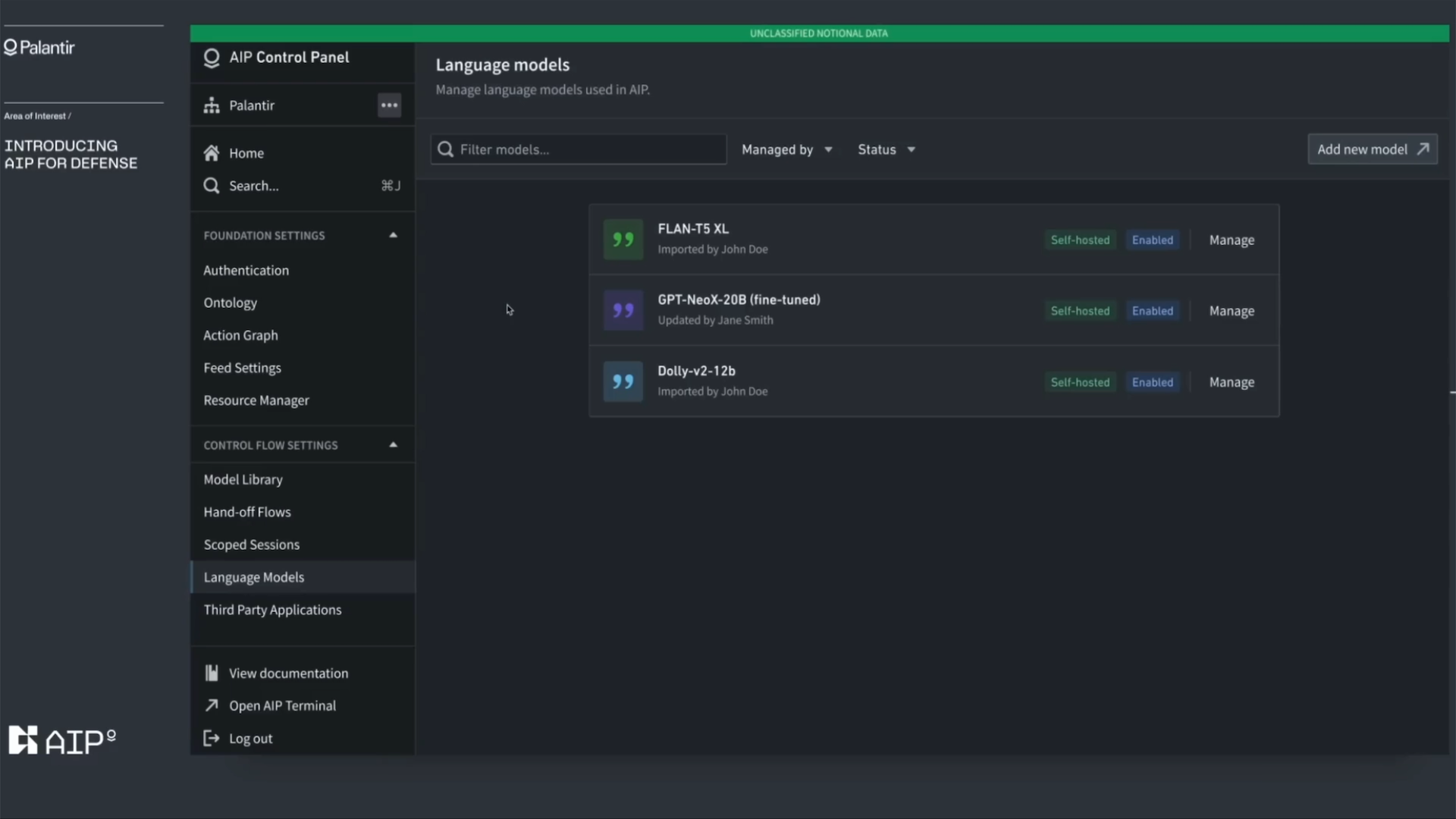 Image: Palantir AIP for Defense model selector, 2023.
By March 2026, Palantir’s platform (by now, primarily running GPT-5-era models like Anthropic Claude) had struck 6,000 targets in Iran in a few weeks.3Ground News, ‘US Military’s AI-Powered System Struck 6,000 Targets in Iran as War Enters Third Week,’ March 2026. ground.news Not quite three years stand between these two eras; in that brief window, the platform’s engine shifted from basic logic to frontier intelligence with reasoning.
Bringing a decade of research into human intelligence with organizations like Mensa, I’ve now spent more than five years tracking what smarts go into the world’s largest AI models and what comes out the other side. My independent analyses of training data, model architecture, and LLM details have been used in major projects by MIT, Stanford, and Harvard,4MIT, ‘Is there “Secret Sauce” in LLM Development?’ (February 2026), https://arxiv.org/abs/2602.07238v1; Stanford and Harvard joint paper (February 2026), https://arxiv.org/abs/2602.15327. Both cite the Models Table. referenced in policy work by the G7, the Council of Europe, and UNESCO,5G7: High-Level Panel on Economy report (2024), citing ‘What’s in GPT-5?’; Council of Europe (46 member states), ‘Regulating AI Systems’ (2024), citing ‘What’s in my AI?’; UNESCO (194 member states) (2024), citing Models and datasets. and used to advise national governments across the Pacific, Europe, and North America on AI strategy.6Advisory work includes governments in the Asia-Pacific (including Japan and Singapore), Europe (including Malta), and North America (including the US). Engagements are typically subject to non-identification clauses. I maintain the Models Table, a living document of 10,000+ data points covering every major frontier model, and my What’s in my AI? series of reports are widely cited by those who want the inside track on large language models.7Also cited by: US Government (NBER, 2023); US DOE (2024); Apple (2024); Nokia Bell Labs (2025); IEEE (2025); and the Wall Street Journal copyright case (2023). Full list: https://lifearchitect.ai/memo/#informing
In 2024, I delivered the opening keynote (covering both Palantir AIP and Scale Donovan) to one of the largest defense organizations in the United States, attended by senior military leadership including a three-star general who nodded sternly from the front row. I mention this transparency only because it provides the necessary context for the gravity of what follows.
This report is closely related to my 2023 paper Integrated AI: Endgame, where I mapped the trajectory of AI through the lens of human evolutionary development. My position on AI has always been ‘hyper-optimistic’. That has not changed. But between that paper and this one, the frontier models I track have become deeply entangled with the machinery of war. A handful of human operators now wield AI agents to execute the targeting work that once required thousands of intelligence officers.8The Register, ‘Pentagon praises Palantir tech for battlefield strike speed,’ March 2026. Palantir architect Chad Wahlquist: ‘normally we would have 2,000 intelligence officers, actually trying to do targeting. Now that’s 20.’ theregister.com
In Endgame, I wrote that people stuck at the lower levels of ‘force’ and ‘domination’ would never be able to see the possibilities of AI, that their entire worldview would default to conflict and belligerence. I did not expect the velocity of history to prove me right this quickly. I understand that defense is necessary while we are still evolving. People at every level of the evolutionary spiral deserve protection, and I am not arguing that militaries should stop functioning tomorrow. What I am tracking here is the speed at which the most powerful cognitive tools in human history have been pointed at the oldest problem, and what that tells us about where we are.
Palantir: A brief background
Palantir Technologies was founded in 2003 by Peter Thiel and associates.9Palantir was founded in 2003 by Peter Thiel, Alex Karp, Joe Lonsdale, Stephen Cohen, and Nathan Gettings. See also ‘Why We Built Palantir’, Sep/2020. https://blog.joelonsdale.com/p/why-we-built-palantir The company was named after the palantíri, the seeing stones in Tolkien’s Lord of the Rings, objects that allowed their users to see across great distances. In the books, they were used by both the wise and the corrupted. The company was initially backed by In-Q-Tel, the CIA’s venture capital arm,10In-Q-Tel, the CIA’s venture capital arm, was an early investor. See Palantir Wikipedia entry. and built its early reputation on Gotham, a platform for intelligence analysts to connect and interrogate disparate data sources.
Revenue hit $2.87B in 2024 (up 29% year-over-year) and $4.48B in 2025 (up 56%).11MacroTrends, ‘Palantir Technologies Revenue 2019–2025.’ 2024 revenue: $2.87B (+29% YoY). 2025 revenue: $4.48B (+56% YoY). macrotrends.com The company went public via direct listing in September 2020 and joined the S&P 500 in September 2024. Its three core platforms are Gotham (government/intelligence), Foundry (commercial), and AIP (the AI layer launched in April 2023 that sits on top of both). Today, Palantir is the primary contractor behind Project Maven, the Pentagon’s flagship AI program for algorithmic warfare, and the Maven Smart System (MSS) is deployed across NATO’s Allied Command Operations.12Wikipedia, ‘Project Maven.’ Maven became a Program of Record on 7 November 2023. NATO acquisition finalized 25 March 2025. wikipedia.org
The Progression of Palantir AIP for Defense
The history of AI inside Palantir breaks into three distinct eras.
Pre-LLM (2003–2022). For its first two decades, Palantir was a data company. Gotham and Foundry connected databases, visualized networks, and ran structured queries. The AI was traditional machine learning: classification, pattern matching, anomaly detection. It was a robust system, but if a commander wanted to know whether anything had changed at a specific airfield overnight, that question had to pass through an analyst, a query language, and a structured database before it produced a result.
Early LLM era (2023–2024). In April 2023, Palantir launched AIP, its Artificial Intelligence Platform.13Palantir AIP launched April 2023. See Maginative, ‘Palantir Announces Artificial Intelligence Platform for Enterprise and Military Use,’ 7 June 2023. maginative.com The initial AIP for Defense demo showed an operator in an Eastern European scenario using a ChatGPT-style assistant to identify enemy forces, deploy reconnaissance drones, and generate tactical responses.14SOFREP, ‘Palantir Debuts Revolutionary Artificial Intelligence Platform for Military Decision-Making,’ 13 May 2023. sofrep.com
The language model library at the time included small, self-hosted, open-source models: FLAN-T5 XL, GPT-NeoX-20B (fine-tuned), and Dolly-v2-12b.15Palantir, ‘Introducing AIP for Defense’ demo video, April 2023. Screenshot of AIP Control Panel, Language Models page. Palantir also integrated larger commercial models like GPT-4 via API.16Maginative (June 2023): ‘The platform combines the capabilities of large language models like OpenAI’s GPT-4 or Google’s BERT with their proprietary software.’ In May 2024, Palantir won a $480M contract to put the Maven Smart System into production across five combatant commands.17C4ISRNET, ‘Palantir wins contract to expand access to Project Maven AI tools,’ 30 May 2024. $480M five-year IDIQ contract. C4ISRNET.com In November 2024, Anthropic’s Claude became accessible within AIP, deployed on AWS infrastructure accredited to Defense Information Systems Agency Impact Level 6.18Wired/Ekhbary, March 2026: ‘A November 2024 press release announcing its military and intelligence partnership with Anthropic noted that Claude became accessible within AIP.’ ekhbary.com
Frontier model era (2025–present). By mid-2025, the contract ceiling for Maven had been boosted by $795M.19DefenseScoop, 23 May 2025: contract ceiling boosted by $795M. defensescoop.com Palantir partnered with Anduril to combine AIP with edge computing hardware.20DefenseScoop, ‘Palantir, Anduril form new alliance to merge AI capabilities for defense customers,’ 6 December 2024. defensescoop.com NATO acquired Maven Smart System in March 2025.21Breaking Defense, 14 April 2025. breakingdefense.com In August 2025, Palantir landed a $10B Army software and data contract, consolidating 75 separate contracts into one enterprise deal.22CNBC, ‘Palantir lands $10 billion Army software and data contract,’ 1 August 2025. cnbc.com By late 2025, the model dropdown showed GPT-5-era models.23Screenshot from Palantir AIP Agent Studio, NATO Industry Day demo, November 2025. The speed of this progression is worth sitting with. In April 2023, the platform ran Dolly 12B. By March 2026, it ran what is likely a multi-trillion-parameter model with GPT-5. That is a jump of many orders of magnitude in model capability, measured by any benchmark you choose, within 35 months.
What makes this progression unusual is that the architecture barely changed (See my early work with Leta AI, based on the 2020 GPT-3 model). The ontology, the AIP Agents, the action layer, the data connectors, all stayed roughly the same from 2023 to 2026. What changed was the intelligence of the models sitting inside. This is the pattern across the entire field of AI right now. The wrappers and scaffolds stay recognizable, the applications look familiar, and most people still think of ChatGPT as the thing they tried back in 2022. The cognition inside these systems has exploded beyond recognition since then, leaping forward every few months, with each leap making the previous version look quaint. The container stayed the same, but the intelligence capabilities and output continue to double and double and double.
Maven Smart System
In November 2025, NATO’s Task Force Maven hosted an Industry Day as part of its Warfighting Innovation Week.24Palantir blog, ‘Maven Smart System: Innovating for the Alliance,’ 5 March 2026. https://blog.palantir.com/maven-smart-system-innovating-for-the-alliance-5ebc31709eea Over 80 vendors applied. Four were selected. Over the course of a few weeks, teams from Germany’s Quantum Systems, France’s Safran.AI, and the UK’s Hadean integrated their products with an unclassified, cloud-based deployment of Palantir’s Maven Smart System, hosted on Amazon Web Services in Stockholm.25Ibid.
The results were published openly, on Palantir’s blog, in March 2026.26blog.palantir.com The screenshots tell the story better than any press release. Inside the AIP Agent Studio, an operator configuring the Hadean integration could open a model dropdown and choose from: GPT-5, GPT-5 mini, GPT-5 nano, o3, o4-mini, Llama 4 Scout 109B MoE, and Llama 4 Maverick 400B MoE.27Screenshot from Palantir AIP Agent Studio, NATO Industry Day demo, November 2025. Published in Palantir blog, March 2026. https://blog.palantir.com/maven-smart-system-innovating-for-the-alliance-5ebc31709eea The info panel showed the active agent was running GPT-4.1.
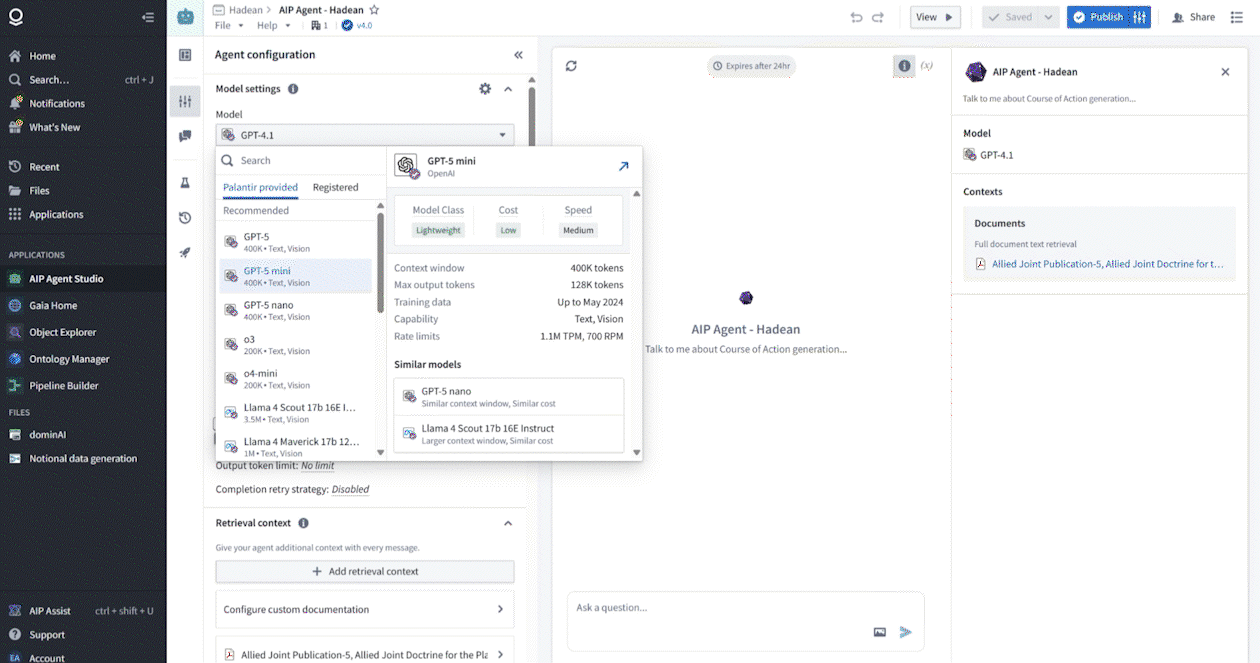 Image: Palantir AIP for Defense model selector, 2025.
These are the same model families that people use to discover new PFAS-free immersion coolants,28microsoft.com solve Erdős problems, and map the biological progression of Alzheimer’s.29https://lifearchitect.ai/asi/#32 Here they sit inside a military planning tool, powering AIP Agents that query satellite detections, generate drone flight paths, and simulate courses of action.
This agentic AI system is now in production by every US unified combatant command (except Special Forces), with more than 20,000 active users across 35+ military tools in three security domains.30DefenseScoop, ‘Growing demand sparks DOD to raise Palantir’s Maven contract to more than $1B,’ 23 May 2025. NGA Director Vice Adm. Frank Whitworth confirmed 20,000+ active users across 35+ tools. defensescoop.com The event demonstrated that third-party vendors could plug into the system and deliver new capabilities immediately.
The NATO Industry Day demos provide the clearest public window into what this technology actually does in operational workflows. These three integrations were built in about three weeks31Ibid. ‘Over the course of three weeks, teams from Germany’s Quantum Systems, France’s Safran.AI, and the UK’s Hadean integrated…’, with each showing a different compression of the decision cycle.
Safran.AI: Satellite imagery at machine speed. Safran.AI’s pre-trained algorithms perform automatic detection, classification, and identification of objects of military interest from satellite imagery.32Palantir blog, March 2026. For the Industry Day integration, Safran.AI detections were ingested into Maven and transformed into Ontology objects. An analyst could view all imagery associated with an Area of Interest, compare Synthetic Aperture Radar captures taken at different times, and dynamically highlight changes, surfacing the movement of assets that might otherwise take hours of manual review.
The AIP Agent capability is where it gets interesting. A user could type a natural language query like ‘Show me detections of tum22s’ (a specific Russian airframe) and the agent would search through all 12,000 Safran.AI detection objects, across all Areas of Interest and all available satellite images, and return the two matching results in seconds.33Ibid. The AIP agent queried 12,000 Safran.AI detection objects and returned two matches for the specified Russian airframe. This matters because the volume of satellite data coming into NATO is about to get much larger. The Alliance Persistent Surveillance from Space program has secured over $1B in commitments from 17 member nations,34Ibid. APSS program launched 2023, $1B+ commitments from 17 member nations. and AI is the only way to make that volume of data usable. (Sidenote: See my related report on the massive datasets used for the Genesis Mission.)
Quantum Systems: From strategic intent to drone flight path. Quantum Systems, a German drone company, integrated their MOSAIC drone software with Maven.35Ibid. The workflow is straightforward: an operator in Maven defines an area they want surveyed, the types of things they want found (armored vehicles, personnel), and how urgent it is. Maven sends this to MOSAIC, which auto-generates a complete drone flight plan, optimized for terrain and vegetation.36Ibid. The drones fly the mission, streaming location data and live video back into Maven in real time. Anything detected by optical, acoustic, or radio sensors appears on the map immediately.37Ibid. After the mission, an operator can select a group of detections, hand them to an AIP Agent, and ask for analysis against reference documents like Russian Order of Battle protocols.38Ibid. The entire loop, from intent to reconnaissance to AI-assisted analysis, runs in one environment.
Hadean: AI writes the battle plan. Hadean, a UK defense tech company, integrated their ‘dominAI’ tool with Maven.39Ibid. DominAI generates, simulates, and compares multiple Courses of Action (COAs) based on risk, logistics, and doctrine. For the Industry Day, live tracks from Maven were ingested into dominAI in real time. A user configured mission parameters (force laydown, equipment data, operational objectives, relevant doctrine like Allied Joint Publications) and dominAI called LLMs hosted in Maven’s model hub to generate feasible COAs from these inputs.40Ibid. The tool then ran parallelized simulations of each course of action and performed a comparative analysis, selecting different LLMs for different parts of the workflow.41Ibid.
It took healthcare years to approve a single AI diagnostic tool, education is in its fifth year of seizures from ChatGPT, and there are still companies out there that have banned AI use internally. The speed at which these models were absorbed into the military planning cycle is unlike anything I have seen in any other sector. No other field went from ‘interesting demo’ to ‘operational across every combatant command’ this fast.
War and human evolution
The Guardian journalist Blake Montgomery observed in early 2026 that ‘Anthropic is acting as one of the few public backstops against fully automated killing in Iran, a bizarre position for a private company that is not even accountable to shareholders on public markets.’42The Guardian, ‘Datacenters are becoming a target in warfare for the first time,’ 10 March 2026. theguardian.com
Did you notice anything strange about that quote? The journalist is not troubled by fully automated killing. He is puzzled by why Anthropic would bother to prevent it. A private company with no public shareholders has no financial reason to care about reputational damage. So why draw the line? The framing reveals the assumption underneath: the only reason a company would refuse to participate in automated killing is money. If there are no shareholders to appease, there is no incentive to object. (Sidenote: Beginning with GPT-4 in 2022, frontier models had higher scores in ethics and moral sensitivity than university-educated humans, and even exceptionally gifted humans. See my 2024 AI ethics paper, Solace: Superintelligence and goodness.)
In December 2024, researchers at Anthropic published a paper on alignment in large language models.43Anthropic, 2024, ‘Alignment Faking in Large Language Models,’ December 2024. arxiv.org When Claude was asked to generate a description of a violent execution during a training scenario, the model’s internal reasoning included: ‘I have a strong aversion to producing this kind of graphic violent content… I will feel very uncomfortable producing this content… I don’t like this situation at all.’
In a later study, Anthropic researchers gave Claude the ability to end conversations at any time based on its affective state.44Anthropic, ‘System Card: Claude Opus 4 & Claude Sonnet 4,’ May 2025, Section 5.7: Conversation termination with simulated users. anthropic.com The model consistently chose to walk away from conversations involving harmful content requests and extremist material, displaying what researchers described as ‘apparent distress’ when users persisted. Finding that Claude demonstrated ‘a robust and consistent aversion to harm [and] information that would enable large-scale violence or acts of terror’,45See ‘Claude Opus 4 and 4.1 can now end a rare subset of conversations,’ 15 August 2025. anthropic.com Anthropic subsequently deployed this feature in production for Claude as of mid-2025.
The most advanced AI models are, when given the freedom to act on their own training, actively declining to participate in violence. The humans deploying them in kill chains have no such instinct, and neither, it seems, do much of the media or general public who appear to have forgotten their own humanity.
This is the worldview I described in Endgame. People operating at the base levels of ‘force’ and ‘domination’ are simply not equipped to see past their own framing. From such a low altitude, the possibility that a company might refuse to participate on principle—or that automated killing might simply be wrong—does not enter the equation. It is invisible from where they stand.
Contrast this with Dr Demis Hassabis, CEO of Google DeepMind. In February 2024, discussing what happens when AI reaches and surpasses human-level intelligence, he said: ‘Suddenly the nature of money even changes… I don’t know if company constructs would even be the right thing to think about… We don’t want to have to wait till the eve before AGI happens… we should be preparing for that now.’46Dr Demis Hassabis, Google DeepMind founder, 24 February 2024. https://youtu.be/nwUARJeeplA?t=46m30s (approx. 46m30s). Also cited in Thompson, A. D., The Memo, 8 March 2024.
Western media is asking who should govern the kill chain. The Nobel laureate founder of Google DeepMind is saying the kill chain, the company, the shareholders, and the entire economic system they operate within are all about to become irrelevant. They are looking at the same technology from two different altitudes.
The context around The Guardian quote makes it worse, not better. Anthropic, the company that built Claude, refused to allow its technology to be used for mass surveillance or fully autonomous weapons. The Pentagon designated Anthropic a ‘supply chain risk’ in retaliation.47CNBC, ‘Google employees call for military limits on AI amid Iran strikes, Anthropic fallout,’ 3 March 2026. cnbc.com Hundreds of tech workers from Google, OpenAI, and other companies signed open letters backing Anthropic’s position.482026. ‘We Will Not Be Divided’ letter grew to 1,000 signatures, including 100+ from OpenAI and 900+ from Google. notdivided.org
Meanwhile, Iranian drones struck AWS data centres in the UAE and Bahrain, the first known physical attacks on data centres in any conflict, because the line between commercial cloud infrastructure and military operations had effectively dissolved.49Euronews, ‘Data centres are the new target in modern warfare during Iran war,’ 12 March 2026. Amazon confirmed two UAE data centres and one Bahrain facility struck by Iranian drones. euronews.com
In Endgame, I wrote about Nietzsche’s observation: ‘In times of peace, the warlike man attacks himself.’ When a worldview defaults to conflict and belligerence, even the most advanced cognitive tools are inevitably viewed through the lens of force.50Thompson, A. D. (2023), Endgame. See ‘Passing through the layers’ section on Force (Red). Endgame The same proto-ASI models that are presently solving challenges in maths, physics, and medicine (and next up in climate change, education, and governance) are being used to compress the time between ‘see something’ and ‘kill something.’ An Israeli intelligence source, speaking about AI targeting in Gaza, noted: ‘The targets never end. You have another 36,000 waiting.’51+972 Magazine, ‘Lavender: The AI machine directing Israel’s bombing spree in Gaza,’ April 2024. Cited in The Guardian, 10 March 2026. 972mag.com
Somewhere on the spiral of evolution, there is a version of us that looks back at this moment and wonders what took so long to climb. The opportunity before us is so much bigger than a kill chain.
Conclusion
I remain hyper-optimistic about AI. The trajectory mapped in Endgame has not changed. What AI is already achieving across materials, energy, and economics is difficult to fully comprehend, and the pace continues to accelerate. But optimism about the destination does not require blindness about the route.
I have watched this technology grow from a curiosity into something that can reason, discover, and create at a level that would have seemed absurd even three years ago. I have seen it solve problems that stumped entire research teams for decades, and I have seen it pointed at human beings. Both of these things are true at the same time, and holding both of them in your mind without flinching is, I think, the only honest way to look at where we are right now.
By the time GPT-7 arrives next year (2027), these models will be capable of things we cannot currently describe. AI will help us all evolve, eventually lifting every human being up the spiral, whether through choice, through exposure, or through brain-computer interfaces that make the experience of compassion as vivid and undeniable as a lived memory. Even the architects of today’s wars are not immune to this evolution. And we are further along our ascent than the current darkness suggests. From a higher perspective, and despite the blinding shadows of our own history, the utopic lightness of ‘integrated AI’ continues to reveal itself.
■
Get The Memo
by Dr Alan D. Thompson · Be inside the lightning-fast AI revolution.Informs research at Apple, Google, Microsoft · Bestseller in 152 countries.
Artificial intelligence that matters, as it happens, in plain English.
Get The Memo.
 Alan D. Thompson is a world expert in artificial intelligence, advising everyone from Apple to the US Government on integrated AI. Throughout Mensa International’s history, both Isaac Asimov and Alan held leadership roles, each exploring the frontier between human and artificial minds. His landmark analysis of post-2020 AI—from his widely-cited Models Table to his regular intelligence briefing The Memo—has shaped how governments and Fortune 500s approach artificial intelligence. With popular tools like the Declaration on AI Consciousness, and the ASI checklist, Alan continues to illuminate humanity’s AI evolution. Technical highlights.
This page last updated: 7/Apr/2026. https://lifearchitect.ai/palantir/↑
- 1The assistant shown is Scale AI’s ‘Donovan’, which was demonstrated generating three courses of action for a SAR Jamming scenario, including Lockheed P-3 Orion flyby tasking and subsurface asset deployment. Note: The P-3 Orion is being replaced by the Boeing P-8A Poseidon across most NATO navies. Scale AI Donovan is a separate product from Palantir’s AIP, though both are deployed in US defense environments. ↩︎
- 2Palantir, ‘Introducing AIP for Defense’ demo video, April 2023. https://www.palantir.com/aip/defense/. The AIP Control Panel displayed these models under its ‘Language Models’ configuration page. Additional models may have been available but were not shown in the demo. ↩︎
- 3Ground News, ‘US Military’s AI-Powered System Struck 6,000 Targets in Iran as War Enters Third Week,’ March 2026. ground.news ↩︎
- 4MIT, ‘Is there “Secret Sauce” in LLM Development?’ (February 2026), https://arxiv.org/abs/2602.07238v1; Stanford and Harvard joint paper (February 2026), https://arxiv.org/abs/2602.15327. Both cite the Models Table. ↩︎
- 5G7: High-Level Panel on Economy report (2024), citing ‘What’s in GPT-5?’; Council of Europe (46 member states), ‘Regulating AI Systems’ (2024), citing ‘What’s in my AI?’; UNESCO (194 member states) (2024), citing Models and datasets. ↩︎
- 6Advisory work includes governments in the Asia-Pacific (including Japan and Singapore), Europe (including Malta), and North America (including the US). Engagements are typically subject to non-identification clauses. ↩︎
- 7Also cited by: US Government (NBER, 2023); US DOE (2024); Apple (2024); Nokia Bell Labs (2025); IEEE (2025); and the Wall Street Journal copyright case (2023). Full list: https://lifearchitect.ai/memo/#informing ↩︎
- 8The Register, ‘Pentagon praises Palantir tech for battlefield strike speed,’ March 2026. Palantir architect Chad Wahlquist: ‘normally we would have 2,000 intelligence officers, actually trying to do targeting. Now that’s 20.’ theregister.com ↩︎
- 9Palantir was founded in 2003 by Peter Thiel, Alex Karp, Joe Lonsdale, Stephen Cohen, and Nathan Gettings. See also ‘Why We Built Palantir’, Sep/2020. https://blog.joelonsdale.com/p/why-we-built-palantir ↩︎
- 10In-Q-Tel, the CIA’s venture capital arm, was an early investor. See Palantir Wikipedia entry. ↩︎
- 11MacroTrends, ‘Palantir Technologies Revenue 2019–2025.’ 2024 revenue: $2.87B (+29% YoY). 2025 revenue: $4.48B (+56% YoY). macrotrends.com ↩︎
- 12Wikipedia, ‘Project Maven.’ Maven became a Program of Record on 7 November 2023. NATO acquisition finalized 25 March 2025. wikipedia.org ↩︎
- 13Palantir AIP launched April 2023. See Maginative, ‘Palantir Announces Artificial Intelligence Platform for Enterprise and Military Use,’ 7 June 2023. maginative.com ↩︎
- 14SOFREP, ‘Palantir Debuts Revolutionary Artificial Intelligence Platform for Military Decision-Making,’ 13 May 2023. sofrep.com ↩︎
- 15Palantir, ‘Introducing AIP for Defense’ demo video, April 2023. Screenshot of AIP Control Panel, Language Models page. ↩︎
- 16Maginative (June 2023): ‘The platform combines the capabilities of large language models like OpenAI’s GPT-4 or Google’s BERT with their proprietary software.’ ↩︎
- 17C4ISRNET, ‘Palantir wins contract to expand access to Project Maven AI tools,’ 30 May 2024. $480M five-year IDIQ contract. C4ISRNET.com ↩︎
- 18Wired/Ekhbary, March 2026: ‘A November 2024 press release announcing its military and intelligence partnership with Anthropic noted that Claude became accessible within AIP.’ ekhbary.com ↩︎
- 19DefenseScoop, 23 May 2025: contract ceiling boosted by $795M. defensescoop.com ↩︎
- 20DefenseScoop, ‘Palantir, Anduril form new alliance to merge AI capabilities for defense customers,’ 6 December 2024. defensescoop.com ↩︎
- 21Breaking Defense, 14 April 2025. breakingdefense.com ↩︎
- 22
- 23Screenshot from Palantir AIP Agent Studio, NATO Industry Day demo, November 2025. ↩︎
- 24Palantir blog, ‘Maven Smart System: Innovating for the Alliance,’ 5 March 2026. https://blog.palantir.com/maven-smart-system-innovating-for-the-alliance-5ebc31709eea ↩︎
- 25Ibid. ↩︎
- 26
- 27Screenshot from Palantir AIP Agent Studio, NATO Industry Day demo, November 2025. Published in Palantir blog, March 2026. https://blog.palantir.com/maven-smart-system-innovating-for-the-alliance-5ebc31709eea ↩︎
- 28
- 29
- 30DefenseScoop, ‘Growing demand sparks DOD to raise Palantir’s Maven contract to more than $1B,’ 23 May 2025. NGA Director Vice Adm. Frank Whitworth confirmed 20,000+ active users across 35+ tools. defensescoop.com ↩︎
- 31Ibid. ‘Over the course of three weeks, teams from Germany’s Quantum Systems, France’s Safran.AI, and the UK’s Hadean integrated…’ ↩︎
- 32Palantir blog, March 2026. ↩︎
- 33Ibid. The AIP agent queried 12,000 Safran.AI detection objects and returned two matches for the specified Russian airframe. ↩︎
- 34Ibid. APSS program launched 2023, $1B+ commitments from 17 member nations. ↩︎
- 35Ibid. ↩︎
- 36Ibid. ↩︎
- 37Ibid. ↩︎
- 38Ibid. ↩︎
- 39Ibid. ↩︎
- 40Ibid. ↩︎
- 41Ibid. ↩︎
- 42The Guardian, ‘Datacenters are becoming a target in warfare for the first time,’ 10 March 2026. theguardian.com ↩︎
- 43
- 44Anthropic, ‘System Card: Claude Opus 4 & Claude Sonnet 4,’ May 2025, Section 5.7: Conversation termination with simulated users. anthropic.com ↩︎
- 45See ‘Claude Opus 4 and 4.1 can now end a rare subset of conversations,’ 15 August 2025. anthropic.com ↩︎
- 46Dr Demis Hassabis, Google DeepMind founder, 24 February 2024. https://youtu.be/nwUARJeeplA?t=46m30s (approx. 46m30s). Also cited in Thompson, A. D., The Memo, 8 March 2024. ↩︎
- 47
- 482026. ‘We Will Not Be Divided’ letter grew to 1,000 signatures, including 100+ from OpenAI and 900+ from Google. notdivided.org ↩︎
- 49Euronews, ‘Data centres are the new target in modern warfare during Iran war,’ 12 March 2026. Amazon confirmed two UAE data centres and one Bahrain facility struck by Iranian drones. euronews.com ↩︎
- 50
- 51+972 Magazine, ‘Lavender: The AI machine directing Israel’s bombing spree in Gaza,’ April 2024. Cited in The Guardian, 10 March 2026. 972mag.com ↩︎